- Flight from Amsterdam
- Marrakesh nearly 4 hours
- Time difference
- 1 hour behind, summer 2
- Currency
- Dirham, a closed currency
- Language
- Arabic, Tamazight, also French
- Entry for Dutch citizens
- Passport, visa-free to 90 days
Overview
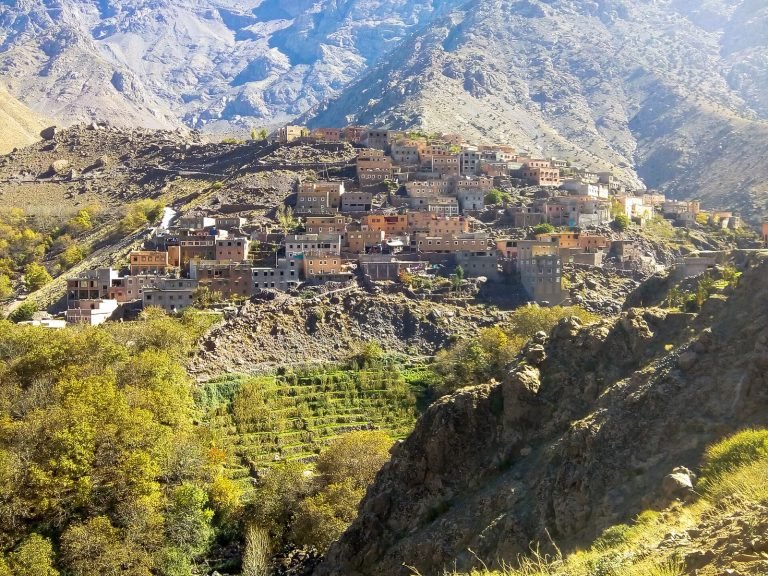
In Morocco very different landscapes lie close together. From Marrakesh you can be in the mountains within two hours, and over the Tizi n'Tichka pass you reach the earthen villages and gorges of the south. In the north lie Fes and Meknes, with their old city centres.
The country suits walking, culture and small stays in an old city or a mountain village. In the mountains you walk with a licensed local guide. That is the standard we propose.
- Short flight, little jet lag From Amsterdam it takes nearly four hours to fly to Marrakesh, with a small time difference. That also suits a short trip.
- City and mountain in one week Toubkal lies just over 60 kilometres from Marrakesh, so medina and mountain village fit into one programme.
- Houses around a courtyard Many old houses in Marrakesh, Fes and Essaouira are now guesthouses. That small scale suits a small group.
Regions
Fes and the north
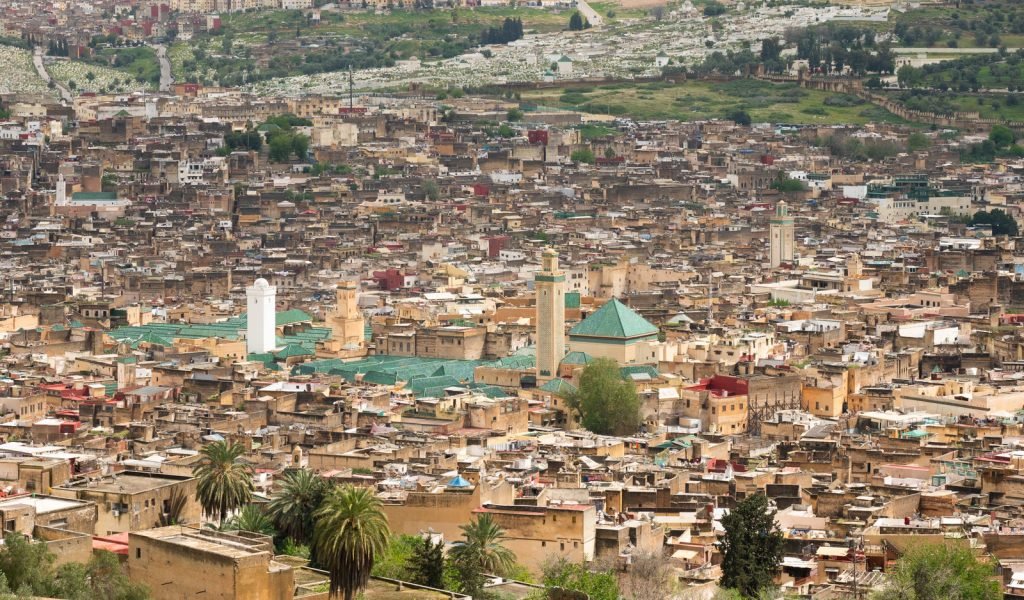
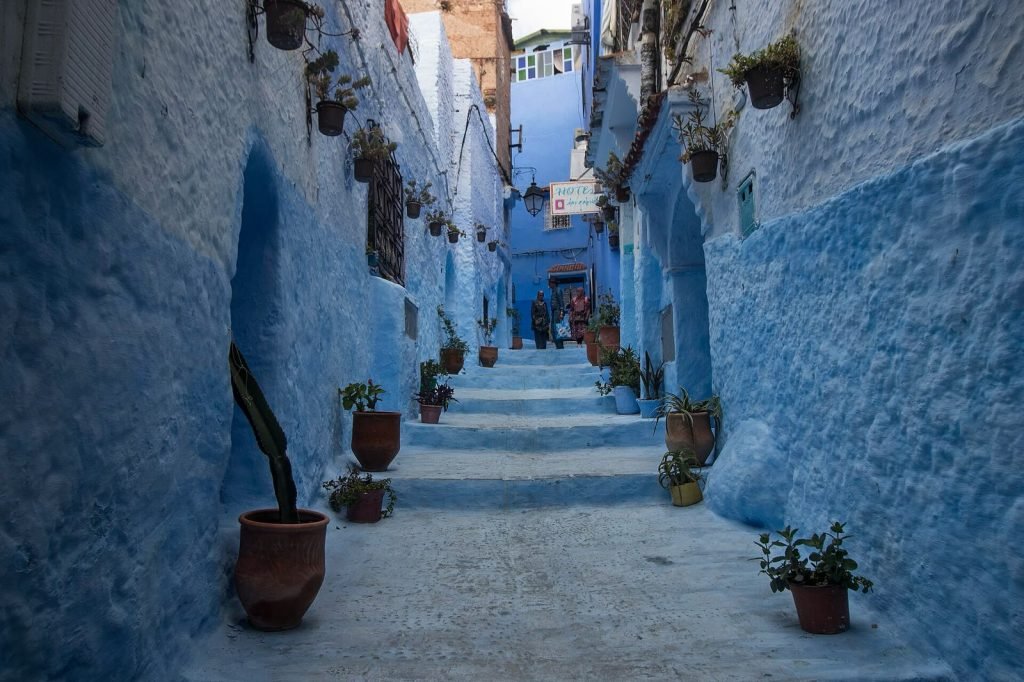
Fes el Bali is the oldest part of Fes, and the medina has been on the World Heritage List since 1981 for its pre-modern layout. Walk it with a guide who carries an official badge. About an hour away lies Meknes, with Volubilis nearby, a partly excavated Amazigh-Roman city. Further north is Chefchaouen with its blue houses, in the mountains of the Rif.

High Atlas
Toubkal, at 4,167 metres, is the highest peak in North Africa and lies 63 kilometres south of Marrakesh. Imlil, a mountain village at about 1,740 metres, is the starting point. After the 2023 earthquake tourism soon returned, but reconstruction in the region is still going on. We therefore plan routes and overnight stays around the situation at the time, with a licensed local guide.

Kasbahs and gorges
Aït Benhaddou is an earthen ksar on the old caravan route between the Sahara and Marrakesh, a World Heritage site since 1987. You get there over the Tizi n'Tichka pass, which can occasionally close for snow in December and January. Further east the Dadès cuts through walls of 200 to 500 metres. Near Tinghir lies the Todgha Gorge, with walls up to 400 metres high.

Marrakesh and Essaouira
The medina of Marrakesh has been on the World Heritage List since 1985 and is where many trips begin. Marrakesh is warm: nearly 38 degrees on average by day in July. Essaouira on the Atlantic coast, a World Heritage site since 2001, stays around 18 to 22 degrees by day all year. That makes it the place to go when the interior gets too hot.




What a day can look like
An illustrative example. We shape your own day with you.

From the Phoenicians to independence
- 12th century BC Phoenicians set up trading posts along the Mediterranean coast.
- 3rd century BC Volubilis arises as capital of Mauretania and later becomes a Roman outpost.
- 789 The Idrisids found Fes, the oldest of the four imperial cities.
- 1070 The Almoravids found Marrakesh, later the capital of the Almohads.
- 1912 Morocco becomes a French and Spanish protectorate.
- 1956 Morocco becomes independent. Muhammad V takes the title of king in 1957.
At the table in Morocco

Tagine
Both the clay pot with its conical lid and the slow-simmered stew cooked in it.

Couscous
Semolina with meat, vegetables or fish, traditionally on Fridays. UNESCO heritage since 2020, shared with Algeria, Tunisia and Mauritania.

Harira
Soup with lentils, chickpeas, onion, coriander and spices, traditionally eaten when breaking the fast.

Pastilla
A savoury pastry, traditionally filled with pigeon and a national favourite in Morocco.
In the medinas you often sleep in a riad, an old town house with rooms around a courtyard, sometimes with a fountain or orange trees. Outside the cities there are small guesthouses and lodges, and in the desert bivouac camps.
When to go
For Marrakesh and the south, March to May and late September to November are the most comfortable. Walking in the High Atlas, below the snow line, suits April to June and September and October. Higher ground in winter is for guided trips only. In summer the interior gets hot, while Essaouira stays mild. Keep Ramadan in mind.
| Region | January | February | March | April | May | June | July | August | September | October | November | December |
|---|---|---|---|---|---|---|---|---|---|---|---|---|
| Fes and the north | less suitable | less suitable | possible | good period | good period | good period | less suitable | less suitable | good period | good period | possible | less suitable |
| High Atlas | less suitable | less suitable | possible | good period | good period | good period | possible | possible | good period | good period | possible | less suitable |
| Kasbahs and gorges | possible | possible | good period | good period | good period | less suitable | less suitable | less suitable | possible | good period | good period | possible |
| Marrakesh and Essaouira | possible | possible | good period | good period | good period | possible | possible | possible | good period | good period | good period | possible |
good period possible less suitable
Start planning it yourself
Slide through the year
Marrakech
- Daytime
- 29 °C
- Night
- 15 °C
- Rain
- 10 mm
Fes
- Daytime
- 26 °C
- Night
- 12 °C
- Rain
- 38 mm
Long-term averages, not a forecast. Periods and the way rain days are counted differ between weather services. Sea temperature: rounded average for 2023 to 2025, for open water off the coast. Bays can be warmer or colder.
Flying from Amsterdam
- Marrakech± 4 hours
Since 20 September 2026 Morocco keeps GMT all year. It is 2 hours behind the Netherlands in summer and 1 hour behind in winter.
Flight times are approximate and apply to a direct flight. Timetables change by season.
How far is it really?
From Marrakech over the Atlas to the Sahara and Fes. About 23 hours of driving in all.
Marrakesh
- Aït Benhaddou3.5 hrs
- Boumalne Dades3 hrs
- Merzouga4.5 hrs
- Fes8 hrs
- Chefchaouen4 hrs
Drive times are approximate, without stops or traffic. A coach takes longer.
World Heritage on the map

Medina of Fez 1981
Show as a list
- Medina of Fez 1981
- Medina of Marrakesh 1985
- Ksar of Ait-Ben-Haddou 1987
- Historic City of Meknes 1996
- Archaeological Site of Volubilis 1997
- Medina of Essaouira 2001
- Rabat, Modern Capital and Historic City 2012
Say it yourself
The pronunciation is a guide, not an exact rendering.
Good to know
- Money
- Moroccan dirham (MAD)
- Plug
- C/E, 230 V. Dutch plugs usually fit. Older plugs without a hole for the earth pin may not fit type E.
- Entry
- Dutch passport, valid for the whole stay. No visa for up to 90 days. Current travel advice
Rules for Dutch citizens with a Dutch passport. Always check the current travel advice just before you leave.
Practical
Checked on 5 November 2026. Before you leave, always check NederlandWereldwijd.nl for current travel advice and entry rules.
- Travel advice Dutch travel advice is yellow for most of Morocco, orange for the border area with Algeria and red for the border area with Mauritania. Check NederlandWereldwijd before you book.
- Entry Dutch citizens need a passport valid for the whole trip. No visa is needed for stays of up to 90 days. Check NederlandWereldwijd before you book.
- Time difference Morocco went back to GMT on 20 September 2026. It is now 1 hour behind the Netherlands in Dutch winter and 2 hours behind in Dutch summer. Older guidebooks are wrong on this.
- Money The dirham is a closed currency, usually available only on arrival. Tips are customary for guides, drivers and in restaurants, but not compulsory. Bring small notes.
- Language and plugs Arabic and Tamazight are the official languages, and French is widely used. Plugs are types C and E.
- Health and water Care outside the big cities is limited, so take insurance with repatriation cover. Use bottled or filtered water, and ask GGD Reisvaccinaties which vaccinations you need.
- Customs Avoid physical contact in public. Alcohol is allowed in bars, hotels and indoors, not on the street. Carry your passport or a copy. Read in the travel advice what the law says about relations outside marriage and between people of the same sex.
- Ramadan Ramadan in 2027 is expected to begin around 8 February and to run until early March. Do not eat, drink or smoke in public by day. The exact dates depend on the moon, so check them before you book.
Frequently asked
Are the times in older programmes still right?
Check them. Morocco returned to GMT on 20 September 2026 and is now 1 hour behind the Netherlands in winter and 2 hours behind in summer. Old schedules for transfers and meeting times can therefore be an hour out.
Can a group visit the High Atlas after the 2023 earthquake?
Dutch travel advice does not name the area separately: it is yellow, like most of the country. Tourism has returned, but rebuilding continues. So ask per village which paths and overnight stays are available now.
Does the group need a local guide?
We found no official text making a guide compulsory on Toubkal. The UK government does advise a professional guide for walking in the Atlas. In medinas, look for an official badge and permission from the local authority.
What does Ramadan mean for the programme?
In 2027 it is expected to begin around 8 February. Do not eat or drink in the street by day, and check shop and restaurant hours. People who are fasting can be tired and traffic around sunset can be erratic, so avoid transfers at that hour.
What should we watch for with room allocation?
The travel advice says couples without a marriage certificate or proof of registered partnership may be given separate rooms. Bring such proof if you can. Also read what the advice says about relations outside marriage and between people of the same sex.
What we can offer
- On request: a walking trip in the High Atlas with a licensed local guide
- On request: a cultural trip past Fes, Meknes and Volubilis
- On request: a trip over the Tizi n'Tichka to the kasbahs and gorges
- On request: a stay in small places in the medina or the mountains
- On request: a guide or tour leader for your own organisation's programme